
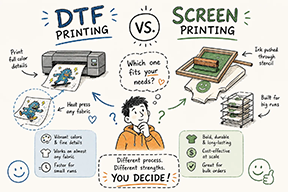
DTF printing vs screen printing: which is right for you?
When weighing DTF printing vs screen printing, picking the wrong method isn't just a minor inconvenience. You're out setup fees you can't recover, stuck with shirts that look wrong on the fabric you chose, or scrambling at the last minute because the turnaround was longer than you expected. The good news is that this decision is simpler than most people make it. Once you know your order size, design complexity, fabric, and deadline, there's a clear answer. Here's how to figure out which method is right for you.
How DTF printing vs screen printing actually work
The DTF process from file to fabric
Direct-to-film printing works by printing your design onto a special PET film using inkjet technology, then coating that film with a hot-melt adhesive powder. The powder gets cured, and the finished transfer gets heat-pressed onto your garment under pressure. Think of it as a precision heat-transfer that bonds directly to the fabric surface. Because it's a digital process, there are no screens involved, no per-color setup fees, and file prep for most jobs takes only a few minutes.
How screen printing layers ink onto a shirt
Screen printing works differently at every step. Each color in your design gets burned onto its own mesh screen, and then ink is pressed through each screen in sequence directly onto the garment. A three-color design requires three screens, three setups, and three carefully aligned passes. The result is ink that cures into the fabric structure itself, which explains why the durability profile is different from a surface-bonded transfer.
Why the process shapes everything else
Every practical difference between these two methods, including cost, minimums, turnaround, and fabric compatibility, traces back to this mechanical difference. Screen printing front-loads cost and time into setup. DTF spreads cost more evenly because setup is minimal. Once you understand that, the rest of this comparison makes immediate sense.
Cost per shirt at every order size
DTF printing cost per shirt across small and large runs
DTF material costs run roughly $1.05 to $1.95 per shirt, with small one-off jobs often quoted at $4 to $10 per shirt depending on the shop and design complexity. At 100 shirts, expect to pay around $2.00 to $2.50 per shirt for a typical design. The cost curve is relatively flat because there's no screen setup fee to spread across the order. Whether you're printing one shirt or fifty, the per-unit math doesn't shift dramatically.
Screen printing setup costs and per-shirt economics
Screen printing setup costs are real and upfront. Each color requires its own screen, and per-screen fees vary by shop, often adding a meaningful fixed cost before a single shirt is printed. On a one-to-ten shirt order, those fees dominate everything, pushing your effective per-shirt cost to $5 to $10 or more. At 100 shirts or above, the math flips completely. A simple design can run $0.60 to $1.20 per shirt because that setup cost is spread across enough units to become negligible.
Where DTF printing vs screen printing hits the break-even point
For a simple one-to-two color design, direct-to-film vs screen printing typically reaches cost parity somewhere between 24 and 48 pieces, though the exact number depends on color count and shop pricing. Below that threshold, DTF is almost always cheaper. Above it, screen printing gets more competitive. There's an important caveat, though: the more colors in your design, the longer DTF stays cost-effective at higher volumes. Every additional color in a screen print job adds another screen and another setup fee, which pushes the break-even point higher in DTF's favor.
Minimum orders, setup time, and turnaround
DTF for single pieces and on-demand small batches
DTF commonly has no minimum order at many shops, though some may still charge a per-order fee. Unlike screen printing, there are no screens to burn and no alignment to dial in, so setup per job takes minutes rather than hours. That matters a lot for event organizers who need 15 custom shirts for a volunteer crew, or a school running three different designs across a few dozen shirts. With DTF, each design is just another file, not another setup fee. If you'd like to see an example of how shops offer DTF as a no-minimum option, check product options like DTF, Custom Provided Apparel.
Why screen printing rewards larger, uniform runs
Screen printing is built for volume efficiency, not flexibility. The economics require spreading setup cost across enough units to justify the upfront labor. Most screen printers set minimums at 12 to 24 pieces, and shops using high-speed automatic presses often require 48 to 72 pieces or more. Multi-color designs push that threshold even higher. This isn't a flaw in the process, it's just how the economics work. Know your quantity before you commit.
Rush timelines and on-demand flexibility
Because there's no pre-production screen work involved, DTF orders for small runs can often be completed in a day or a few days, depending on shop workload. Screen printing typically runs five to ten business days to account for screen prep, ink curing, and production scheduling. If you have a hard deadline or a last-minute event, that difference alone can drive the decision. Urgency and screen printing don't mix well unless you're paying a rush premium. If you need a mixed approach for custom orders or want to provide your own garments, see options like DTF, Custom Provided Apparel for reference.
Color complexity and print quality on dark garments
Full-color gradients, photography, and fine detail with DTF
DTF is a digital process, which means it handles gradients, photographic images, fine lines, and unlimited colors with no added cost per color. A ten-color gradient costs exactly the same to produce as a two-color logo. For custom apparel with detailed artwork, team logos with complex shading, or any design that would require six or more screens in a screen printing setup, DTF is the practical and cost-effective choice. For a broader comparison of the two methods and when each makes sense, see this DTF vs screen printing guide.
How multi-color designs change screen printing economics
Every color you add to a screen-printed design adds a screen, setup time, and cost. A four-color design requires four screens and four precisely aligned passes. That's not a reason to avoid screen printing, it's a reason to use it for the right jobs. A two-color logo printed on 200 shirts is a textbook screen printing job. A full-color graphic on 30 shirts is a textbook DTF job. The method isn't better or worse; it's either matched to your project or it isn't.
Printing on dark garments: opacity and underbase differences
Screen printing on dark shirts typically requires a white underbase layer printed first, followed by colors on top. That adds a screen, setup time, and cost, but the result is bold and opaque. DTF handles dark garments more naturally because the adhesive film provides its own opacity layer. Your design sits on top of the fabric with full color regardless of what's underneath, black, navy, or heather gray. For small quantities on dark fabric, DTF removes a lot of friction. For an industry point-by-point comparison of transfer types, see Transfer Express's resource on direct-to-film vs screen-printed transfers.
Fabric compatibility and wash durability
Which fabrics each method handles well
Screen printing performs best on 100% cotton and standard cotton blends. Printing on polyester or moisture-wicking performance fabrics requires specialty low-bleed inks and tighter temperature control to prevent dye migration, which adds cost and complexity. DTF transfers work reliably on cotton, polyester, blends, and dri-fit performance fabrics without additional prep. For sports teams, gyms, or schools ordering performance wear, that versatility is a practical advantage. If you're evaluating fabrics, some providers publish recommended fabric lists for DTF applications to help you choose the best substrate.
Long-term wash durability on cotton and poly blends
Screen printing is the durability benchmark on cotton. Properly cured plastisol ink bonds into the fabric structure and can hold up for years of regular washing without significant fading or cracking. DTF transfers are rated for roughly 50 to 100 washes with proper care, which is more than adequate for most everyday uses. The adhesive film bond is more sensitive to laundering conditions, though. Hot washing, bleach, and high-heat tumble drying shorten the life of any heat-transfer application considerably. For care and washing tips specific to DTF, reference this washing instructions and durability guide for DTF transfers.
Cracking, peeling, and real-world wear
Both methods have failure modes. Screen-printed plastisol can crack over time if the print is too thick or the garment is stretched repeatedly, but well-applied prints handle heavy use without issue. DTF transfers can peel at the edges if the initial heat press application was off, or if the garment is washed under conditions that stress the adhesive bond. The fix on both sides is the same: proper application by someone who knows what they're doing, and reasonable care when laundering.
Choosing the right method for your situation
Use cases that clearly favor DTF
When comparing DTF vs screen printing for smaller or more complex projects, DTF tends to come out ahead. Here's where it makes the most sense:
- Orders below the typical break-even range (commonly around 24 to 48 pieces, depending on color count and shop pricing)
- Full-color, gradient, or photographic designs
- Printing on dark fabrics in small quantities
- Polyester, dri-fit, or performance wear
- Rush orders or last-minute needs
- One-off custom pieces or mixed size/color runs
A small business owner who needs branded staff shirts in six different sizes across two colorways is a classic DTF scenario. At many shops there's no minimum to hit, no setup fees per color, and no waiting on screens to be burned, though it's worth confirming policies with your printer, since fee structures vary.
Use cases where screen printing wins
Screen printing takes over when your order gets larger and your design gets simpler. Orders of 72 pieces or more in the same design, simple one-to-three color logos, 100% cotton garments where long-term durability is a priority, and situations where cost per shirt at scale matters more than design flexibility all point toward screen printing. School spirit shirts in a single color for 200 students are a textbook screen printing job. The setup cost disappears into a per-shirt price that DTF can't match at that volume.
Talk to your printer before you decide
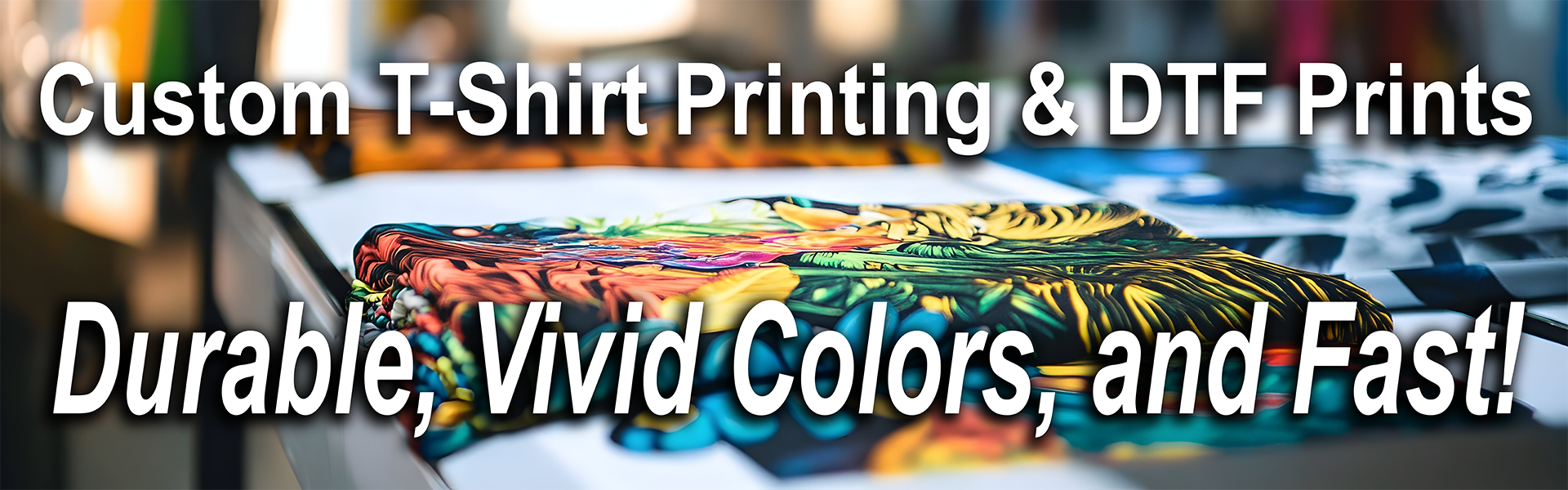
Before you place a large order, get samples and pricing for both methods. A full-service shop that offers both DTF transfers and custom screen printing can look at your design, your quantity, your fabric, and your deadline, then tell you which method actually fits. At Graphx Unlimited in Central Florida, that's exactly the conversation we help customers work through, and there's no reason to push you toward one method if the other is the better fit. That kind of guidance is worth more than any comparison chart. If you want to explore custom options and turnaround times, see our Custom T-Shirt Printing | Fast Turnaround | Graphx Unlimited offering.
The bottom line
Neither method is universally better. DTF wins on flexibility, small runs, complex artwork, and fabric versatility. Screen printing wins on cost efficiency and long-term durability for high-volume, simple designs. The break-even between the two typically falls around 24 to 48 pieces for a simple design, and that threshold moves higher as your color count increases.
When deciding between DTF printing vs screen printing, factor in three things: quantity, design complexity, and fabric type. Those variables will point you toward the right answer almost every time. If you're still unsure, reach out to a trusted local printer and ask for pricing on both methods before you commit. A good shop will tell you which one makes sense for your job, even if it's not the more expensive option.
Still deciding between DTF printing vs screen printing? Get samples and a quote.
Graphx Unlimited offers both methods and can help you compare real costs for your specific project. Contact us for a quote before you commit.
